
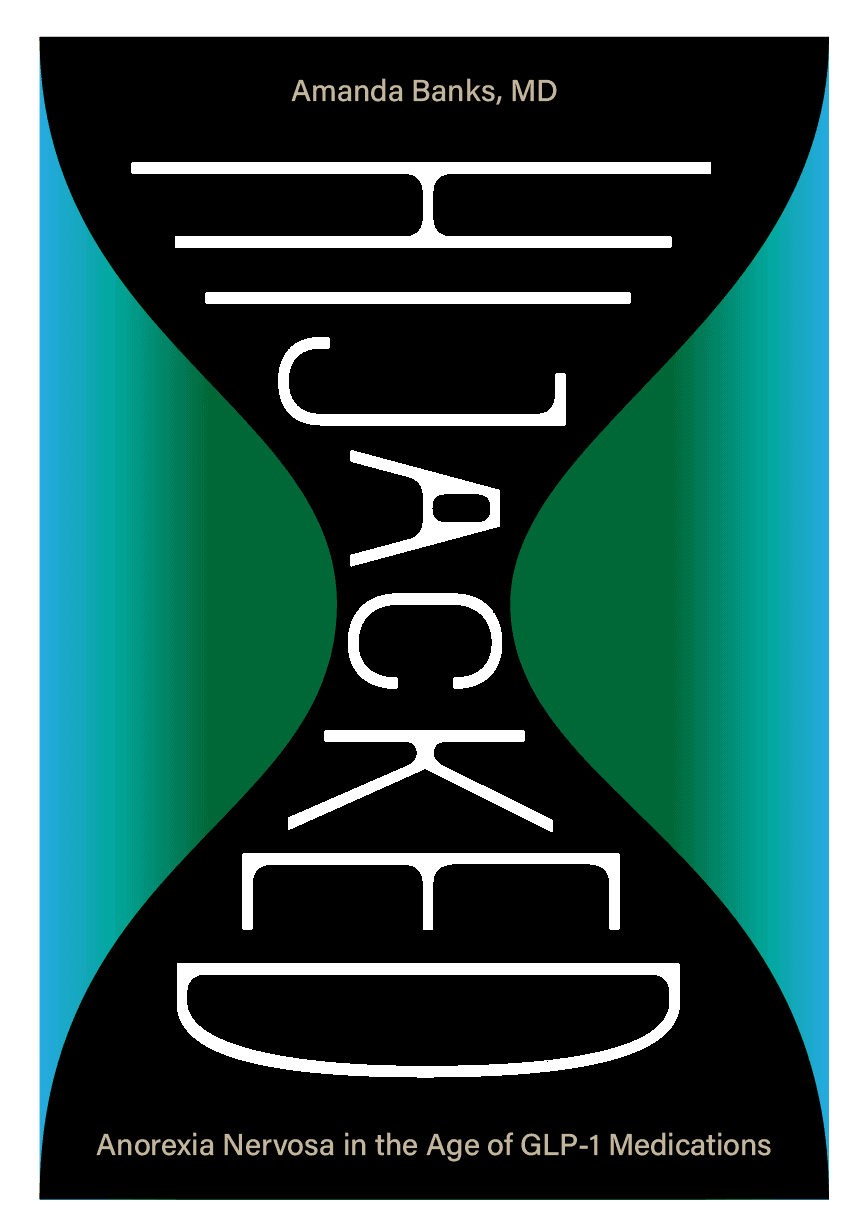
One family's story, an urgent warning
When her 14-year-old daughter was diagnosed with anorexia nervosa, Dr. Amanda Banks, a physician and biotechnology executive, was thrust into a world few parents are prepared for — and one that is becoming terrifyingly common.
Hijacked begins as one family's story of treatment and recovery, but it rapidly unfolds into an urgent public health warning. By synthesizing the evolving science, it reframes anorexia nervosa not as extreme willpower or a lifestyle choice, but as a serious biological disorder with deep genetic roots — one capable of overriding the most fundamental drive shared by every living creature: to eat when hungry.
As GLP-1 weight-loss drugs saturate our culture — reshaping how we think about bodies, hunger, and beauty — they are also driving a rise in anorexia nervosa by hijacking the same biological pathways that underlie the disease. With one in eight American adults now taking GLP-1 agonists and regulations struggling to keep pace, the stakes could not be higher.
Grounded in science and profound human experience, this book equips families with the tools to act, demystifies the biology of a widely misunderstood, common and lethal illness, and makes the case that recovery is always possible. If we choose awareness over inaction, we can turn the rising tide of anorexia nervosa.
There is a path.
Early readers
Coming from the world of high-performance sport, I have seen how deeply conversations around bodies, control, and performance can shape the way people experience themselves. Dr. Amanda Banks brings clarity, compassion, and scientific rigor to a disorder that has long been misunderstood. Hijacked is both deeply human and urgently important.
As the prevalence and human toll of anorexia nervosa climbs in the U.S. and around the world, Hijacked sheds light on this confounding condition and the many ways our modern world pushes kids into disordered eating. With a mother's empathy and a physician's insight, Dr. Banks explains the misunderstood biology of anorexia nervosa and the impact of new GLP-1 weight loss drugs, providing clear advice for supporting those we love as they recover and a clarion call for building a healthier culture around food and eating.
This book enters an urgent and rapidly evolving debate to offer vital evidence-informed insight. It is a powerful call for deeper awareness, further research and more joined-up thinking at a critical moment.
Dr. Amanda Banks addresses two important topics in medicine — anorexia nervosa and GLP-1 agonists — with empathy, evidence and experience. She is a wonderful guide in this important book.
I wish that every parent, every clinician and every pharma scientific officer could read this book. It positions anorexia nervosa brilliantly within the current pharmacologic and cultural landscape and provides a roadmap for transitioning anorexia nervosa from an enigmatic condition into a tractable and treatable metabo-psychiatric disease.